McConnells Mill State Park: Slippery Rock Gorge, Covered Bridge & Glacial Geology
Explore Pennsylvania's most dramatic 400-foot glacial gorge, featuring the rugged 6.2-mile Slippery Rock Gorge Trail, historic 1874 covered bridge, 1868 grist mill, and Class II-IV whitewater rapids.
Key Takeaways
- The “Kildoo Picnic” Hack: Parking directly at the mill and covered bridge is extremely limited (often zero spots on weekends). Park at the Kildoo Picnic Area at the top of the hill and hike the short trail down to the mill to save time and frustration.
- Strict Swimming Ban: Swimming is strictly prohibited in Slippery Rock Creek. The water looks inviting but has dangerous undercuts, deadly currents, and submerged rocks. Rangers actively patrol and ticket for this.
- Footwear is Critical: The sandstone in the gorge isn’t just “rocky”: it grows a thin layer of algae that makes it slicker than ice. Proper hiking boots with aggressive tread are non-negotiable for the Slippery Rock Gorge Trail.
- Grist Mill Tours: The historic mill is only open for tours Wednesday through Sunday (10:30 AM - 3:30 PM) from Memorial Day through late September. Plan your trip mid-week if you want to see the massive turbines in action.
- One-Way Shuttle: If you want to hike the full 6.2-mile Gorge Trail but aren’t up for the 12.4-mile round trip, park a second car at Eckert Bridge (the southern terminus) to avoid the return climb.
McConnells Mill State Park is a rugged wilderness defined by the Slippery Rock Creek Gorge. This 400-foot-deep chasm was carved by glacial lakes 20,000 years ago, resulting in one of the most dramatic landscapes in Pennsylvania.
Massive sandstone boulders the size of trailers litter the gorge floor. The creek roars with rapids. In the center sits a postcard-perfect historic grist mill and covered bridge.
⚠️ Warning: The rocks are genuinely slippery, especially when wet. The moss-covered sandstone offers zero traction. Wear boots with good grip and take your time.
Why Hike McConnells Mill?
The sheer scale of the gorge is humbling. You are walking on the bottom of what was once a catastrophic flood channel. This was created when ice-age lakes breached their dams.
The park is a multi-sport paradise. When the water is up, whitewater kayakers flock to the rapids. Rock climbers test themselves on the Rim Road cliffs. And hikers tackle the Slippery Rock Gorge Trail.
This section of the North Country Trail is notoriously tough. The park earned National Natural Landmark status in 1974 for these features.
The Trails: Choose Your McConnells Mill Adventure
If You Want the Gorge: Slippery Rock Gorge Trail
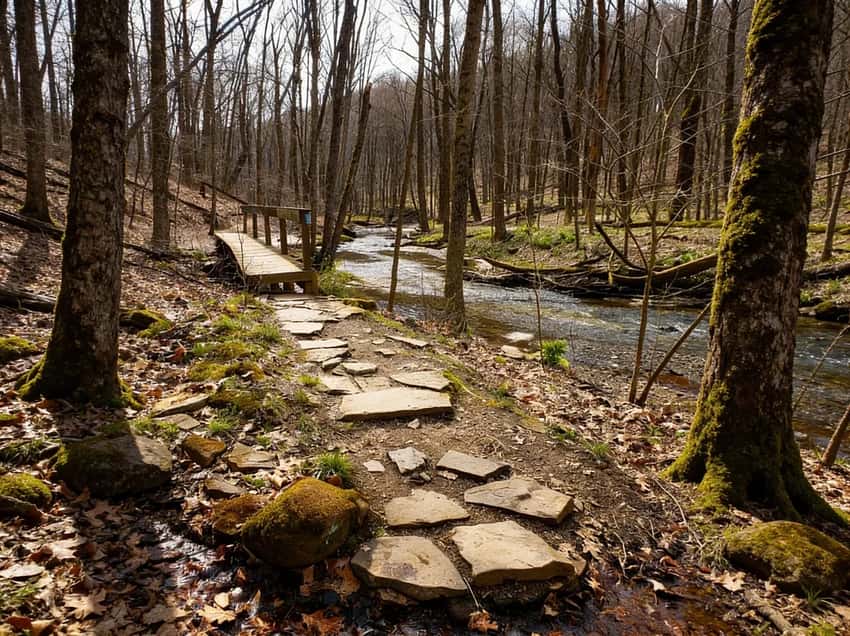
Slippery Rock Gorge Trail:
- Distance: 6.2 miles one-way (12.4 miles round-trip)
- Elevation: 400 ft descent/ascent (gorge depth)
- Time: 6-8 hours round-trip
- Difficulty: Strenuous (rocky, steep, boulder scrambles)
- Trailhead: McConnells Mill parking area or Eckert Bridge parking
- Best Time: Spring (April-May) for high water, fall (September 25-October 10) for foliage
- The Draw: Part of the North Country Trail. Follows the entire length of the gorge to Eckert Bridge
The trail leaves the civilized area of the mill and plunges into the wilder sections of the gorge. You will scramble over boulders and cross tributary streams. Experience the isolation of the canyon floor.
The blue-blazed trail follows Hell Run Valley before descending. Massive boulders force you to pick your way carefully. In places, you will need to use your hands for rock scrambles.
What to Expect:
- Difficulty Reality: This is genuinely strenuous. Not a “scenic stroll with elevation.” Technical rock scrambling required
- Boulder Scrambling: You’ll use hands and feet to navigate car-sized boulders. Some scrambles are steep and exposed. Not suitable for anyone with fear of heights or claustrophobia
- Rock Quality: Moss-covered, wet sandstone. Slippery even on dry days. Wet conditions make this dangerous. Avoid after rain
- Time Reality: 6-8 hours round-trip is accurate. Faster hikers (experienced scrambler fitness) can do it in 5-6. Slower hikers need 8-9 hours
- Hazards: Slippery rocks, exposure on scrambles, cold water crossings, undercuts and strainers in creek
- Water Crossings: Multiple creek crossings. Water is cold year-round. In spring flood, this becomes Class III whitewater
- Crowds: Very light. Most hikers skip this for easier trails. You’ll likely see few people
- Escape Route: No easy exit once you’re in the gorge. Committed to the full loop
- Season: Best spring (April-May) and fall (September-October). Summer is hot on the exposed gorge bottom. Winter is dangerous due to ice
Pro Tip: This is a serious hike. Allow 8 hours for the round trip. Or park a second car at Eckert Bridge for a one-way walk.
Trekking poles are highly recommended. The rocks are slippery year-round. This hike is for experienced hikers only.
If You Want the Waterfall: Hell’s Hollow Trail
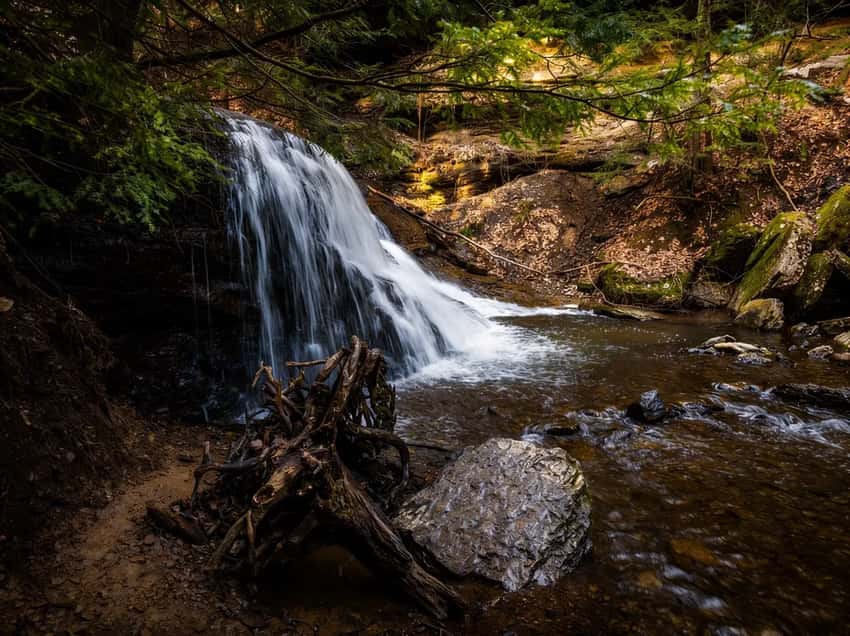
Hell’s Hollow Trail:
- Distance: 0.5 miles out-and-back
- Elevation: 100 ft descent
- Time: 20-30 minutes
- Difficulty: Easy to Moderate (some rocky sections)
- Trailhead: Hell’s Hollow parking area (separate from main mill area)
- Best Time: Spring (April-May) for peak water flow, early morning for fewer crowds
- The Draw: Hell’s Hollow Falls and a historic lime kiln
For a huge payoff with minimal effort, this is the spot. The trail follows Hell Run through a lush, green valley to a cascading waterfall. It’s significantly quieter than the main mill area.
The historic lime kiln near the falls is a remnant of the area’s industrial past. Built in the 1800s, it produced lime for mortar and agricultural use.
Pro Tip: Visit in early spring (April) when snowmelt creates the most dramatic waterfall. The falls can be a trickle by late summer.
If You Want the Creek: Kildoo Trail
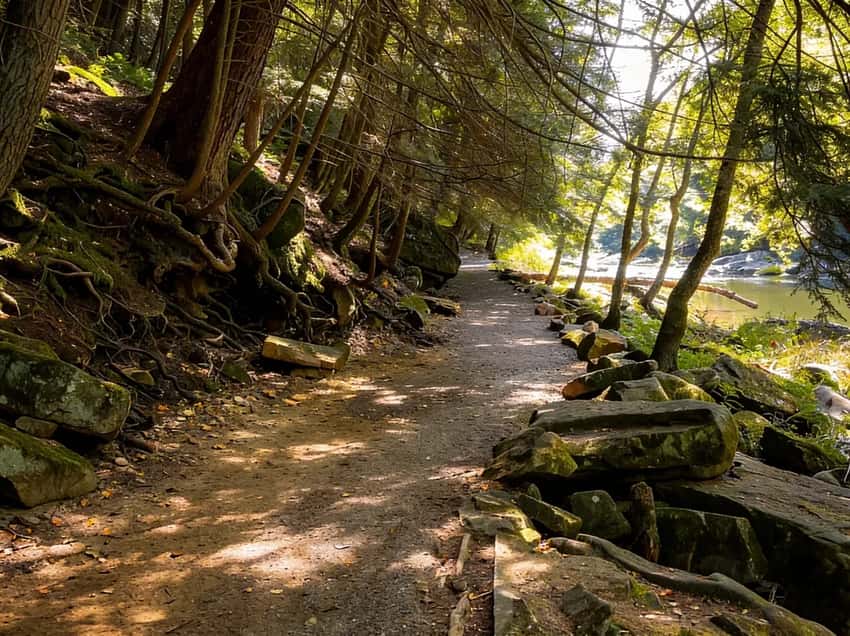
Kildoo Trail:
- Distance: 2.0 miles loop (with road connection)
- Elevation: 150 ft
- Time: 1-1.5 hours
- Difficulty: Moderate (very rocky, hugs the creek)
- Trailhead: McConnells Mill parking area (starts at the Grist Mill)
- Best Time: Summer (June-August) for cooler temps in the gorge
- The Draw: Intimate views of Slippery Rock Creek and the most dramatic boulder fields
This trail hugs the creek, offering constant views of the rushing water and massive boulders. It’s rockier than Hell’s Hollow but shorter than the full Gorge Trail - a perfect middle ground.
If You Want More Miles: Alpha Pass Trail
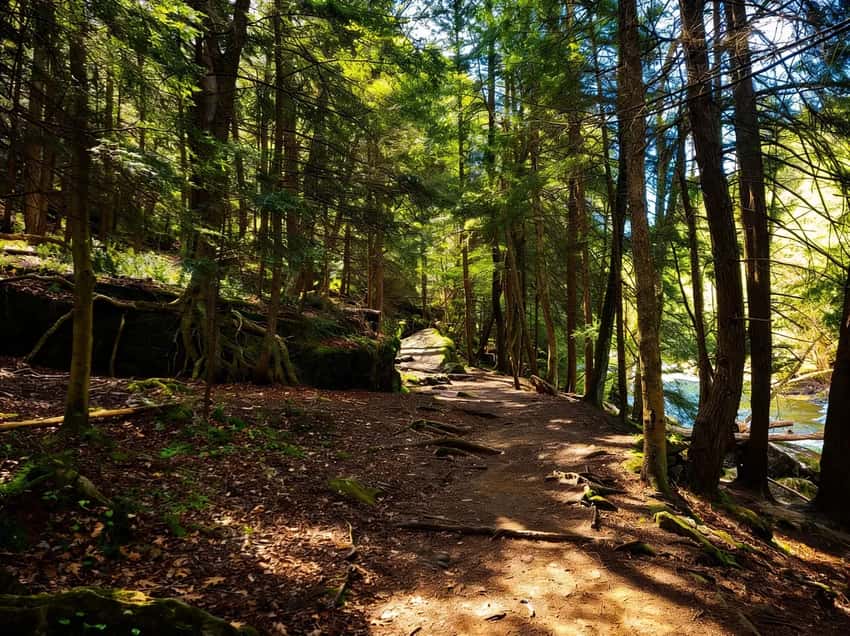
Alpha Pass Trail:
- Distance: 1.5 miles one-way
- Elevation: 200 ft
- Time: 1 hour
- Difficulty: Moderate
- Trailhead: Connects to Slippery Rock Gorge Trail
- Best Time: Fall (September-October) for foliage
- The Draw: A scenic section of the North Country Trail that leads to the “Alpha Pass” rapid area
This trail can be combined with the Slippery Rock Gorge Trail for a longer loop. It offers excellent views of the creek’s rapids and is popular with kayakers scouting the whitewater.
The Grist Mill: Living History
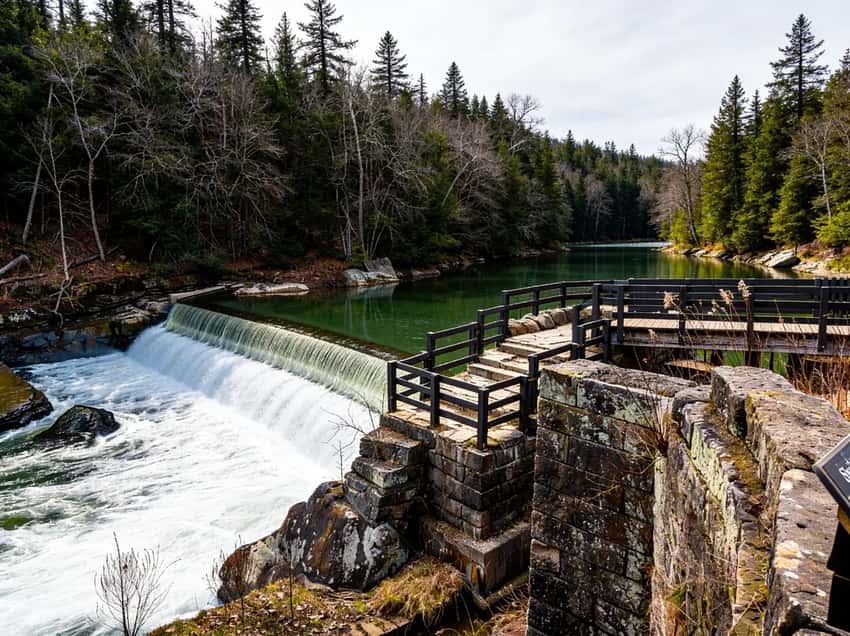
The McConnells Mill is the heart of the park. Built in 1852 by Daniel Kennedy and rebuilt in 1868 after a fire, it harnessed the power of Slippery Rock Creek to grind grain for the local community.
In 1875, Thomas McConnell purchased the mill. He modernized it by replacing the water wheel with water turbines. He also replaced the grindstones with rolling mills.
This made it one of the first rolling mills in the country. This innovation allowed the mill to process grain faster. It was a significant upgrade for the local economy.
The mill operated until 1928, when outdated equipment and declining profits forced it to close. Today, it’s been restored to working condition.
Tours: The mill is open for interpretive tours from Memorial Day through late September, Wednesday through Sunday, 10:30 AM to 3:30 PM. Seeing the massive gears turn and hearing the water turbines rumble is a highlight. Admission is free.
The Covered Bridge: 1874 Icon
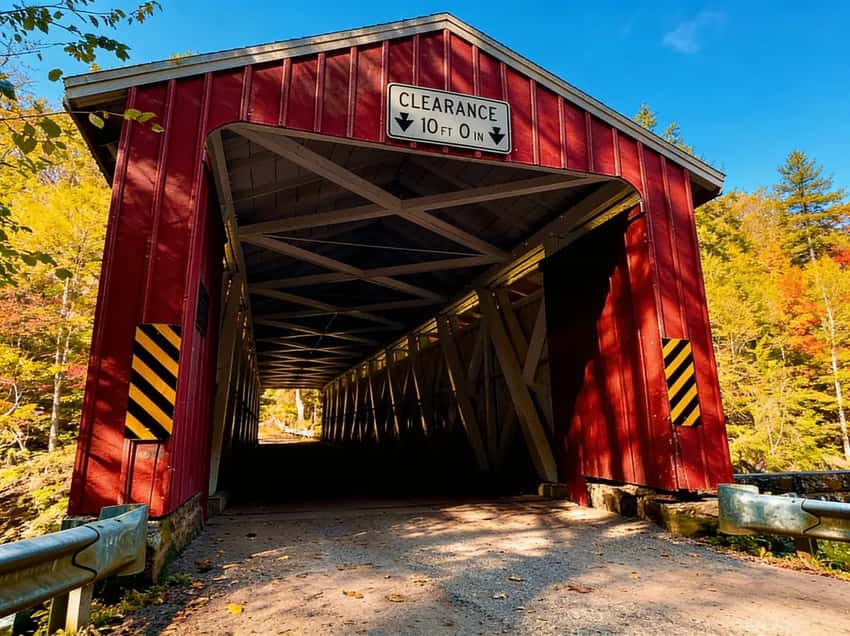
Spanning the gorge right next to the mill is the McConnells Mill Covered Bridge. Built in 1874, it uses a Howe truss design. This is one of only four remaining in Pennsylvania.
Specifications:
- Length: 91 feet
- Built: 1874
- Style: Howe truss (diagonal wooden braces with vertical iron rods)
- Status: Still open to vehicular and foot traffic (one lane)
- National Register: Listed on the National Register of Historic Places
Iconic View: The vibrant red wood against the green hemlocks and grey boulders is one of the most photographed scenes in Western PA. The bridge serves as the primary access point to the mill.
Photography Tip: Shoot from below the bridge (accessible via the Kildoo Trail) for the best angle. Early morning light (7:00-9:00 AM) illuminates the red bridge beautifully. Fall foliage (late September-early October) provides a stunning backdrop.
The Geology: Glacial Drama
The gorge was not carved by a slow river over millions of years. It was blasted out in a geological instant. About 20,000 years ago, massive glacial lakes to the north breached an ice dam.
The resulting torrent of water drained southward. It cut through the bedrock and deposited the massive boulders you see today. Geologists estimate millions of gallons of water flowed through here every second.
Glacial Lakes: The draining of glacial lakes Arthur, Watts, and Edmund created the gorge in a matter of days or weeks, not millennia.
Boulders: The massive sandstone boulders littering the gorge floor were carried by the floodwaters and deposited as the water slowed.
Designation: The entire gorge is a designated National Natural Landmark (1974) for its exceptional geological features.
Trail of Geology: Follow the self-guided interpretive trail to understand the rock formations. Markers explain the glacial history and point out key geological features.
Photography Tips
Shoot from the rim overlooks in the early morning for soft light. Use a wide-angle lens to capture the scale of the gorge. Fall foliage is best between September 25 and October 10.
Shoot from below the bridge via the Kildoo Trail. Early morning light illuminates the red wood beautifully. Include the mill in your frame for better context.
Hell’s Hollow Falls is best in late spring. Use a slow shutter speed (one to two seconds) for a silky effect. Shoot from the base of the falls looking up.
Capture kayakers navigating the rapids from the Kildoo or Alpha Pass trails. Spring offers the most dramatic whitewater. Use a fast shutter speed to freeze the action.
Whitewater Kayaking at Slippery Rock Creek
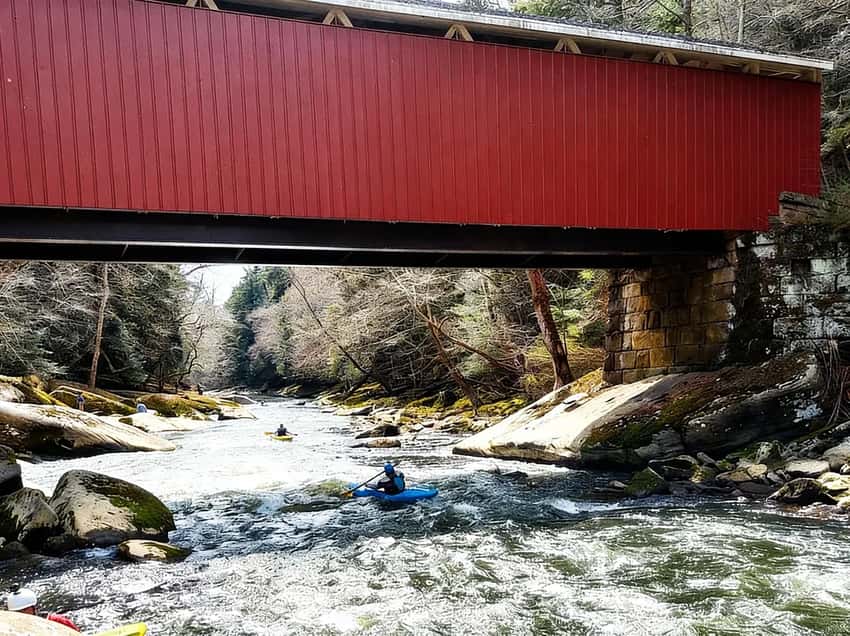
This is premier whitewater in Western Pennsylvania. The creek offers Class II to Class IV rapids depending on water levels.
Class: II-IV rapids (Class III-IV in high water, Class II in low water)
Season: Spring (March-May) for natural high flow, fall release schedules (check with local paddling groups)
Access: Multiple put-in/take-out points along the gorge (McConnells Mill, Eckert Bridge, Breakneck Bridge)
Difficulty: Advanced paddlers only. Technical rapids, boulder gardens, cold water, and undercuts make this dangerous for beginners
Permit: No permit required, but life jackets are mandatory
Water Levels: Check American Whitewater for current flow data before launching
Best Rapids: Alpha Pass, Breakneck Bridge, and the section below the mill offer the most technical whitewater.
This is cold, technical whitewater. Undercuts and strainers are common obstacles. Only experienced paddlers should attempt this creek. Hypothermia is a risk even in the summer months.
Rock Climbing
The Slippery Rock Gorge rim offers excellent sandstone climbing with routes ranging from beginner to advanced. This is serious climbing in a spectacular gorge setting.
Climbing Areas:
Rim Road Climbing Area (Most Popular)
- Location: South rim of the gorge, accessible via Rim Road
- Routes: 30+ established routes ranging from 5.4 to 5.11
- Rock Type: Sandstone (Pottsville Formation). Quality varies. Some routes feature excellent stone. Others are friable
- Heights: Cliffs ranging from 50-80 feet
- Anchor Type: Mix of fixed anchors, natural gear, and bolts (varies by route)
- Approach: 5-15 minute walk from parking
- Best Routes: “Wall Street” (5.6), “Chimney Route” (5.5), “Sandstone Crack” (5.7)
Breakneck Bridge Area
- Smaller crags with technical routes, primarily 5.8-5.10
- Limited parking and approach. Less crowded than Rim Road
- Water Access: Climbers can access whitewater scouting from here
- Season: Best in fall (September-October)
Climbing Logistics:
- Permit: No permit required for day climbing, but climbers must use designated areas
- Groups: Parties of 2-4 climbers typical. Larger groups should split across different routes
- Bolts vs. Gear: Mix of both. Bring cams and nuts for traditional routes. Some routes require sport-climbing quickdraws
- Sandstone Conditions: Friable in some sections. Test holds before committing full weight. Rain makes sandstone unstable (avoid climbing 24 hours after rain)
- Season: June-August (warm, good training). September-October (perfect temps and low humidity). November-March (too wet, rock unstable)
Common Hazards:
- Sandstone Quality: Some sections crumble. Not as solid as granite or limestone
- Loose Rock: Rockfall is possible. Wear helmets and keep others clear of fall zones
- Plant Growth: Moss and lichen make some holds slick. Clean before pulling
- Weather: Gorge traps moisture. Rock dries slowly even after light rain
- Crowds: Popular on weekends, especially fall. Climb on weekdays for solitude
Best Guidebooks & Info: Mountain Project has comprehensive McConnells Mill climbing databases with route details, beta, and current conditions. Local climbing shops in nearby Slippery Rock town have updated information.
Insider Tips
Best Hike Strategy: Don’t do the full 12-mile Slippery Rock Gorge Trail unless you’re experienced. Instead, combine Hell’s Hollow (easy 20-min waterfall) with Kildoo Trail (moderate 1.5 hours). This gives you waterfall + gorge drama without the all-day commitment.
Photography Locations:
- Covered Bridge: Shoot from below via Kildoo Trail for the iconic red-on-green composition. Early morning (7-9 AM) for golden light
- Mill Interior: Visit during tour hours (Wed-Sun, 10:30 AM-3:30 PM) for dramatic machinery shots. The water turbines create interesting motion/stillness contrasts
- Gorge from Rim Road: Wide-angle shots from the overlooks capture gorge scale. Late afternoon (4-6 PM) for side-lighting on the boulder fields
Crowd Management: Weekday mornings (Tuesday-Thursday before 10 AM) are quiet. Weekends bring families to the mill and covered bridge. Hikers gravitate toward Hell’s Hollow and Kildoo. The full Gorge Trail is rarely crowded due to its difficulty.
Water Level Impact: The gorge is best after heavy rain (3+ inches). Water levels surge, rapids get bigger, and waterfalls are dramatic. However, rock scrambles become dangerous when wet. Best compromise: visit 1-2 days after rain when water is up but rocks have partially dried.
Whitewater Community: The kayaking scene here is tight-knit. Local paddlers congregate at the mill parking area. Check American Whitewater forums for trip planning and water level reports. Late March-May is peak paddling season (spring runoff).
Climbing Season: September-October is perfect, cool temps, dry rock, and minimal crowds. June-August climbing is possible but hot. Avoid November-April when rocks are wet from frequent precipitation in western PA.
What You Need to Know Before You Go
Nearby Hubs & Attractions
-
Portersville: Small town 5 minutes from the park. Gas, groceries, and basic services. Population ~300. Historic mill town with antique shops.
-
Moraine State Park (20 minutes): 3,225-acre park with Lake Arthur (the refilled glacial lake that carved the gorge.). Excellent for boating, fishing, and an easier lakeside alternative to McConnells Mill’s rugged terrain. Modern cabins and full camping facilities.
-
Slippery Rock University (10 minutes): Beautiful campus. Library and facilities sometimes open to visitors. Known for geology program, faculty expertise on the gorge’s glacial history.
-
Meridian Benchmark Trail (15 minutes): A lesser-known gem. Ancient oak and hemlock forest. Easy 2-mile loop with no crowds.
-
Parker Dam State Park (30 minutes): Another glacial gorge with different geology (shale instead of sandstone). Less dramatic than McConnells Mill but less crowded.
-
Pittsburgh (45 minutes): Full services, museums, restaurants. Strip District is famous for produce markets and food scene.
-
Foxburg (20 minutes): Tiny historic river town on Allegheny River. Art galleries and a 1892 covered bridge. Great for photos and a quiet lunch.
The creek wasn’t named ironically. The damp environment of the gorge promotes algae and moss growth on the sandstone. Even dry-looking rocks can be slick.
Injuries are common here. Ankle sprains and falls happen regularly. Wear boots with aggressive tread and take your time on the boulder scrambles.
Safety Tips:
- Wear boots with aggressive tread (not sneakers or sandals)
- Use trekking poles for stability
- Take your time on boulder scrambles
- Avoid the trails after rain when rocks are most slippery
No Camping
There is no camping in McConnells Mill State Park.
Solution: Stay at nearby Moraine State Park (20 minutes away), which offers modern cabins, group camping, and tent sites. Reservations can be made via PA State Parks reservations.
The Western Pennsylvania Conservancy Legacy
The Western Pennsylvania Conservancy played a crucial role in establishing the park in 1957. The organization purchased the land and donated it to the Commonwealth.
This was done to protect the gorge and its unique geology from development. Today, the Conservancy continues to support conservation efforts throughout Western Pennsylvania.
Today, the Conservancy continues to support conservation efforts throughout Western Pennsylvania. Learn more at Western Pennsylvania Conservancy.
Nearby Attractions
- Moraine State Park: 20 minutes away. Features Lake Arthur (the refilled glacial lake that created the gorge.), 7-mile paved bike trail, and excellent boating.
- Pittsburgh: 45 minutes south. Full city amenities, museums, and dining.
- Portersville: Tiny village near the park entrance. Gas and convenience stores.
Best Time to Visit
- Spring (March-May): The water is high. This makes for dramatic falls and rapids. Wildflowers carpet the gorge floor.
- Summer (June-August): The gorge stays cool. It’s the best time for tours of the stone mill. Rock climbing is popular.
- Fall (September-October): Spectacular foliage. The hardwoods on the gorge rim turn orange and red.
- Winter (December-March): For the adventurous. The ice formations on the cliffs and falls are stunning. The gorge is quiet and isolated.
FAQ
Is the Slippery Rock Gorge Trail really that hard? Yes. It is rugged, rocky, and long. Do not attempt it in sneakers.
It is a backcountry experience with boulder scrambles and stream crossings. Allow 8 hours for the round trip.
Can you drive across the covered bridge?
Yes. It is a single-lane bridge open to vehicle traffic. Be courteous to pedestrians and wait your turn if another car is crossing.
Is Hell’s Hollow worth it? Absolutely. It’s the easiest hike in the park. It leads to a beautiful waterfall and a historic lime kiln. It’s perfect for families.
Can beginners kayak Slippery Rock Creek? No. The technical rapids, boulder gardens, and cold water make it dangerous for beginners. Only advanced paddlers should attempt the creek.
When is the mill open for tours?
Memorial Day through late September, Wednesday through Sunday, 10:30 AM to 3:30 PM. Admission is free.
Explore More
McConnells Mill is a dramatic glacial gorge. Start with Hell’s Hollow for an easy waterfall hike. Then tackle the Slippery Rock Gorge Trail for a full-day adventure. Don’t miss the historic mill and covered bridge.
Compare this to Ohiopyle for more whitewater. Check out the Laurel Highlands for more mountain adventures. See the full PA State Parks list for more hiking ideas.