Concrete City Nanticoke PA: The Complete Guide to PA's Poured-Concrete Abandoned Town
Built as model 1911 housing for colliery workers, abandoned after just 11 years: the full guide to PA's poured-concrete abandoned town.
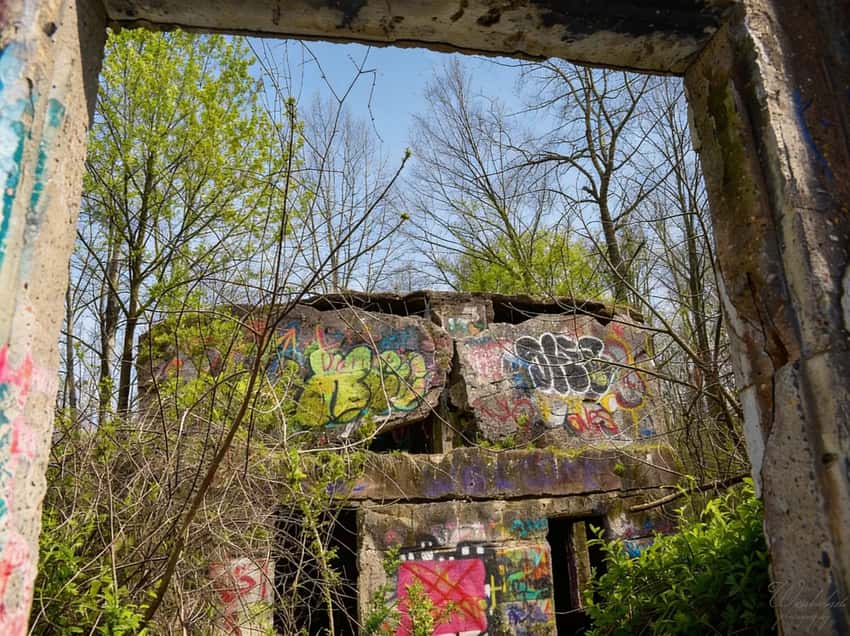
"Parked on the dirt turnout off Front Street. The site is best visited late fall through early spring when ground hazards are clearly visible. Thick boots are mandatory."
Every guide to Concrete City tells you it exists. None of them tell you not to go in July. Visit this Nanticoke site in late summer and you are walking into waist-high weeds, unavoidable poison ivy at every building entrance, broken glass and exposed rebar hidden by vegetation, and one of the highest tick densities in Luzerne County.
Here is the exact GPS, the full history, and why November is the only sensible month to make this trip.
Key Takeaways
- Navigation: Use the dirt access road off Front Street in Nanticoke (Google Maps | Apple Maps). GPS: 41.186939, -75.974001.
- Best Season: Strictly avoid summer. Visit from November to April to ensure hazards like exposed rebar aren’t hidden by weeds.
- History: Explore 22 poured-concrete duplex homes built in 1911 and abandoned just 11 years later, one of the earliest “garden city” experiments.
- Hazards: High tick density and unavoidable poison ivy make summer visits dangerous. Boots and long pants are mandatory year-round.
When to Visit, and When Not To
The right window for Concrete City is November through April. When vegetation dies back you can actually see the ground you are walking on, which matters when the site is covered in collapsed concrete sections, broken glass from decades of informal use, and structural rebar that is no longer attached to anything.
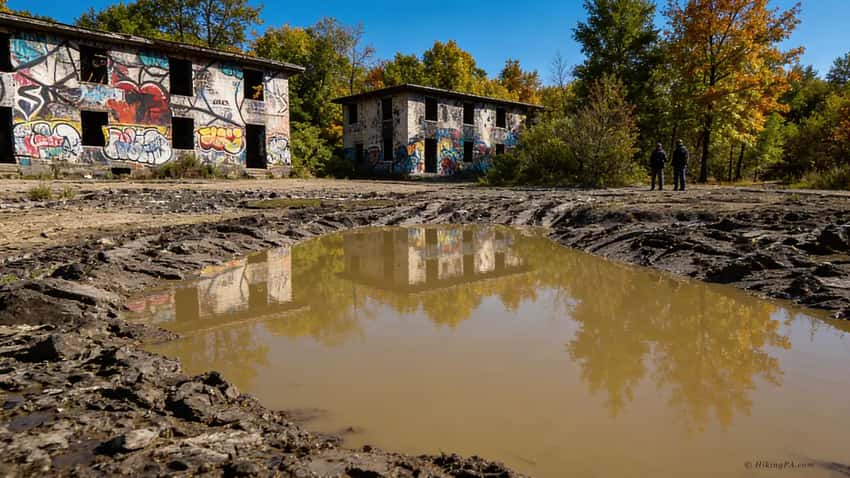
October is the sweet spot: bugs are gone, overgrowth is dying back, and the bare concrete against autumn forest makes for the best photos of the year. May is the last acceptable shoulder-season date before summer vegetation overtakes the building entries and makes the hazards invisible.
Do not go in July or August. Both months bring stagnant water on the access road, patchy poison ivy growing in unavoidable masses at multiple building entrances, and waist-high weeds that completely conceal the structural debris on the ground. If you have ever had to identify poison ivy from touch rather than sight, you understand why summer is the wrong choice here.
How to Find It, Parking and the Unmarked Entrance
There is no sign. There is no gate. There is no trail marker of any kind.
Parking GPS: 41.186939, -75.974001
Drive to those coordinates on Front Street in Nanticoke and park on the shoulder. From your car, look for an unmarked dirt road heading north into the tree line. This is the only indicator you are in the right place.
Pro Tip: Do not drive down the dirt road. It is narrow, deeply rutted, and has mud pits deep enough to ground a standard car. Walk it, regardless of what your vehicle is.
From the shoulder, head up the dirt track approximately 50 yards uphill. The grade eases. Continue another 250 yards on the flat section. The concrete building facades appear through the trees on your left, you will hear them before you see them if there are other visitors inside.
The History: Why It Was Built and Why It Failed
What Concrete City Was
Construction began in 1911. The complex opened for residents in 1913, built by the Delaware, Lackawanna and Western Railroad’s Coal Division for the nearby Truesdale Colliery.
This was not standard labor housing. These were 20 to 22 poured-concrete duplexes built specifically for the colliery’s high-value employees: foremen, engineers, skilled tradesmen, and technicians. The homes were designed to be fire-proof, sanitary, and durable, a deliberate contrast to the hastily built wooden company housing that dominated the anthracite region at the time.
The complex included a central courtyard maintained as public green space, active tennis courts, and a baseball field. The Pennsylvania Historical and Museum Commission described it as the “Garden City of the Anthracite Region” when it designated the site as historically significant in 1998.
The poured-concrete construction technique, casting walls, floors, and ceilings as monolithic units, was an early experiment in industrial residential construction.
Why It Was Abandoned in 1924
The complex lasted eleven years.
There was no indoor plumbing at the time of construction. Residents shared poured-concrete outhouses positioned between the duplexes. This was not unusual for the era, indoor plumbing was not yet standard in working-class housing across the region. What became the problem was what happened after.
As the 1910s turned into the 1920s, municipal expectations for sanitation infrastructure changed. The local township demanded that the complex be connected to a modern sewage system.
Retrofitting plumbing into solid poured-concrete walls and floors, structures designed as single-pour monolithic units, was structurally close to impossible without demolishing and rebuilding each unit from scratch.
The Glen Alden Coal Company, which had acquired the property through the coal industry’s many consolidations, commissioned an engineer’s assessment. The estimate for plumbing retrofit came back at approximately $200,000 (roughly $3.5 million in 2026 dollars). They refused the investment, evicted all residents, and abandoned the complex.
They then tried to demolish it.
Glen Alden used 100 sticks of dynamite per building. The concrete barely chipped. Fully demolishing the complex would have cost approximately as much as the plumbing retrofit they had just declined. They abandoned the demolition effort, walked away, and left the structures standing, where they have remained for a century.
A walk through the Concrete City ruins, showing the scale and layout of the complex.
What Is Left Today
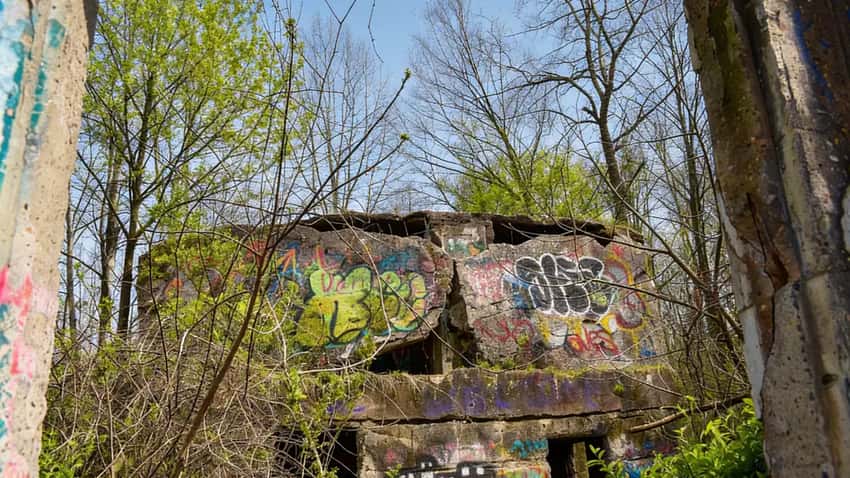
According to Atlas Obscura and the PHMC site records, the shells of the duplex blocks remain arranged in a rough oval around the original courtyard footprint. Roofs have caved in on most units. Walls are partially collapsed in sections. Rebar hangs freely from deteriorating concrete decking.
Interior floors have holes. Some second floors are structurally compromised. Every concrete surface is covered in layered graffiti going back decades.
The site has also served as a training ground for local police, firefighters, and military units. It has also seen informal paintball use.
The combination of graffiti, training damage, and a century of weather has produced a ruin that looks older than its actual age.
The site was formally designated a Pennsylvania historic site in 1998, which provides some documentation and protection but does not fund active preservation. What you see is what you get, and what you get continues to slowly deteriorate.
Hazards and Rules
Ticks: There is a high tick population across the entire site and access road from April through October. Long sleeves, pants, and repellent are baseline requirements.
A post-visit tick check is not optional. Winter visits eliminate this hazard almost entirely. This is another strong reason to go in the cold months.
Poison ivy. Large, established patches grow at multiple building entrance points by late spring. The plants are recognizable in isolation but grow alongside other vegetation in ways that make avoidance difficult in summer. Know what it looks like in spring leaf-out before you park, it gets much harder to identify in peak summer growth.
Footwear. Stiff-soled hiking boots. Broken glass and concrete rubble cover the ground throughout the site, concealed by vegetation in summer and dirt in winter. Trail runners and sneakers do not provide sufficient sole protection against glass and concrete shards. Do not wear sandals under any conditions.
No second floors. Concrete decking is actively deteriorating and exposed rebar makes climbing dangerous. Stay at ground level inside the buildings.
Dogs. The combination of broken glass, exposed rebar, dense tick habitat, mud ruts on the access road, and poison ivy patches makes this a poor site for dogs. Unlike many trails where “dogs not recommended” is precautionary, the hazards here are specific and real. Leave dogs at home or in the car.
Legal access: Concrete City is a publicly accessible historic site. This is “enter at your own risk” territory. No permit is required. Stay on publicly accessible areas and do not attempt to access any fenced or posted sections.
What to Bring
- Hiking boots with stiff soles, the ground demands it
- Long sleeves and pants, even in mild weather from April through October
- Tick repellent containing DEET or permethrin
- Tick removal tool, check before you get in the car
- A water bottle, no facilities of any kind on site or nearby
- Camera, low-angle November light on bare concrete produces the most interesting shots
Best Photos and What to Look For
The most photogenic angles are from the central courtyard area looking at the facing duplex rows. The monolithic poured construction is most visible on interior walls where plaster has fallen away. You can see clearly where the exterior concrete was poured as a single unit with no seams.
The graffiti layers document who has been visiting the site for decades. The layers read chronologically from oldest (lowest) to newest.
The original front entry steps on several units are still intact and give a sense of the domestic scale. The buildings were not warehouses, they were designed to read as normal homes. The contrast between domestic design intentions and current state is what makes the ruins unusual compared to similar industrial abandonment sites in the coal region.
Photography Guide
The best light at Concrete City arrives in the two hours after sunrise from November through February. Low-angle winter sun cuts through the leafless canopy at a shallow enough angle to create long shadows across the textured concrete facades, which makes the surface erosion and graffiti layers read in high relief. Midday light in any season flattens everything and produces dull, overexposed shots of pale concrete.
Specific shots to plan for:
- The central courtyard looking south: Stand at the north end of the oval and shoot back toward the entry-side buildings. You get the full row of facades in a single frame. This angle works best when bare trees frame the upper third of the image in late November or December.
- Interior wall texture: Move inside any ground-floor unit and get close to a section where plaster has fallen away from the monolithic concrete. The pour seams, aggregate texture, and graffiti layers stacked over decades produce images that are more documentary than scenic, and more interesting for it.
- Entry steps at ground level: Several original front-entry concrete steps survive intact. Shooting at ground level with a building facade behind them gives you the clearest sense of the domestic scale the architects were aiming for in 1911.
- Rebar and sky: Look up from inside any roofless unit on an overcast day. The exposed rebar lattice against a flat gray sky reads as an abstract pattern. Overcast conditions eliminate harsh shadows and let the shapes carry the image.
If you shoot in October, the yellow-brown of dying vegetation adds color contrast to the gray concrete that you will not get in deep winter. Bring a wide lens for the courtyard overview and a prime for close work on wall texture.
What to Combine
Concrete City on its own takes under two hours including the drive in and out of Nanticoke. That leaves plenty of time to build a half-day or full-day loop of nearby sites in Luzerne County.
Seven Tubs Nature Area is the most logical pairing. It sits roughly four miles from Concrete City on Bear Creek Road outside Wilkes-Barre. You get a geological contrast that is genuinely striking: the volcanic-origin rock formations and cascading stream at Seven Tubs against the industrial concrete at Nanticoke. Plan about 90 minutes at Seven Tubs. The full Seven Tubs guide covers parking and trail conditions.
Downtown Wilkes-Barre is eight miles north. The paved 2.5-mile Susquehanna River Common trail (accessible at Millennium Circle on River Street) provides a flat, low-effort counterpoint along the river dike after walking uneven rubble at Concrete City.
The Abandoned Pennsylvania Turnpike is a longer detour but fits a full-day abandoned-places itinerary. The abandoned turnpike guide covers access details. If you are making a dedicated Coal Region day, this extends the trip significantly.
For a tighter geographic loop, the city of Nanticoke itself has a compact downtown within a five-minute drive. Local favorites like R-Bar & Grill on Kaska Street and Larry’s Pizza on Market Street offer hearty Coal Region lunch staples. Bringing your own food and eating on the access road shoulder before or after the visit is also an easy option given the quiet location.
FAQ
Is Concrete City legal to visit? Yes. It is a publicly accessible historic site designated by the Pennsylvania Historical and Museum Commission. No permit is required. Stay on accessible areas and avoid posted or fenced sections.
What is the best time of year to go? November through March. Vegetation is dead, ground hazards are visible, ticks are dormant, and the concrete photographs cleanly against bare trees. October is acceptable but the vegetation season is not fully over.
How long does a visit take? The access walk is under 15 minutes each way. Plan 45 minutes to an hour on site if you want to cover the full oval of buildings and the courtyard area. Photography can extend this significantly.
Can I take photographs? Yes. The graffiti and the structural deterioration are not privately owned in any restrictive sense. Photography for personal use is standard.
What happened when they tried to demolish it with dynamite? Glen Alden Coal Company used 100 sticks of dynamite per building after abandoning the site in 1924. The poured-concrete monolithic construction absorbed the blasts with minimal structural damage. Full demolition would have cost roughly as much as the plumbing retrofit they had already declined, so they stopped and walked away. The buildings have stood for a century since.
Are there guided tours? No commercial guided tours operate at Concrete City on a set schedule. The Luzerne County Historical Society and regional preservation groups periodically organize special walking lectures and clean-up days, but for day-to-day visits, you are entirely self-guided.
Concrete City is one stop in a broader Coal Region history itinerary that rewards time. If you are driving through Luzerne County, pair it with the Seven Tubs Nature Area four miles away, an easy morning that covers two completely different versions of the region’s character.
It is also featured prominently in our curated guide to the best abandoned places in Pennsylvania. For an unforgettable full-day exploration of Pennsylvania’s industrial ruins, pair Concrete City with the smoldering subterranean mine fire and abandoned street grids of Centralia, located just 45 minutes south.
For the wider Northeast PA and Poconos region, the regional guide covers what else is within range.