Seven Tubs Wilkes-Barre PA, Glacial Potholes Waterfall Hiking Guide
Discover Seven Tubs Nature Area near Wilkes-Barre: glacial waterfall hike, parking logistics, swimming rules, and seasonal hiking tips. Easy 0.3-mile trail plus moderate 1.8-mile Audubon Loop option.
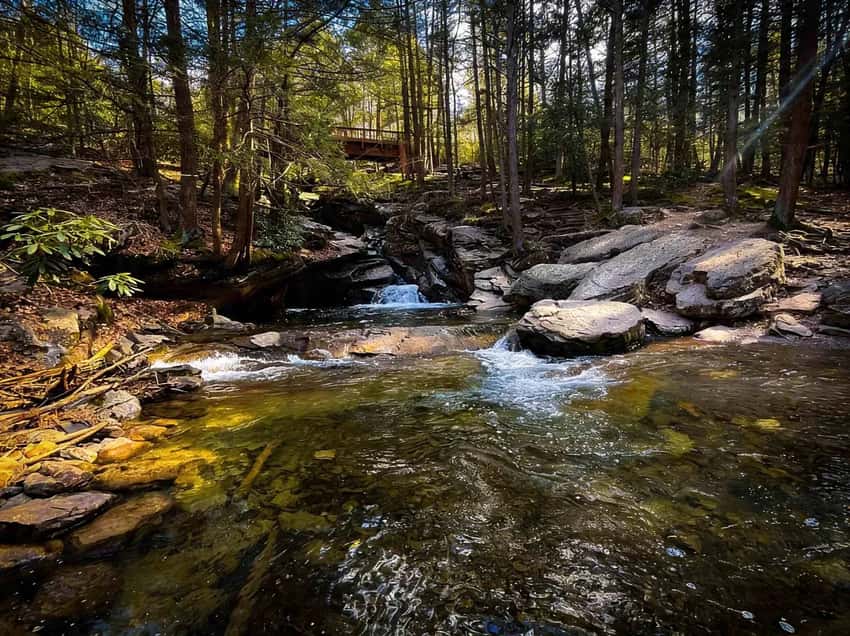
Seven Tubs Nature Area near Wilkes-Barre is one of northeastern Pennsylvania’s most striking waterfall hikes, but it comes with critical logistical constraints. The site reopened in April 2024 after a $1.5 million infrastructure overhaul that added new parking, rebuilt bridges, and installed safety platforms. Yet parking remains the limiting factor: once the 59-car lot fills, the park closes. And despite their swimming-hole appearance, the glacial potholes are strictly off-limits for water entry.
Seven Tubs Nature Area Video Guide
Expert video guide showing the trail conditions and key viewpoints for this section.
This guide covers everything you need to know: the two main trail options (quick 0.3-mile loop vs. moderate 1.8-mile ravine hike), exact parking procedures, seasonal timing to avoid lockouts, and why the geology here is genuinely rare.
Key Takeaways
- Navigation: Park at the main Bear Creek Blvd lot (Google Maps | Apple Maps). GPS: 41.2292, -75.8119. The site reopened in 2024 with 59 paved spaces.
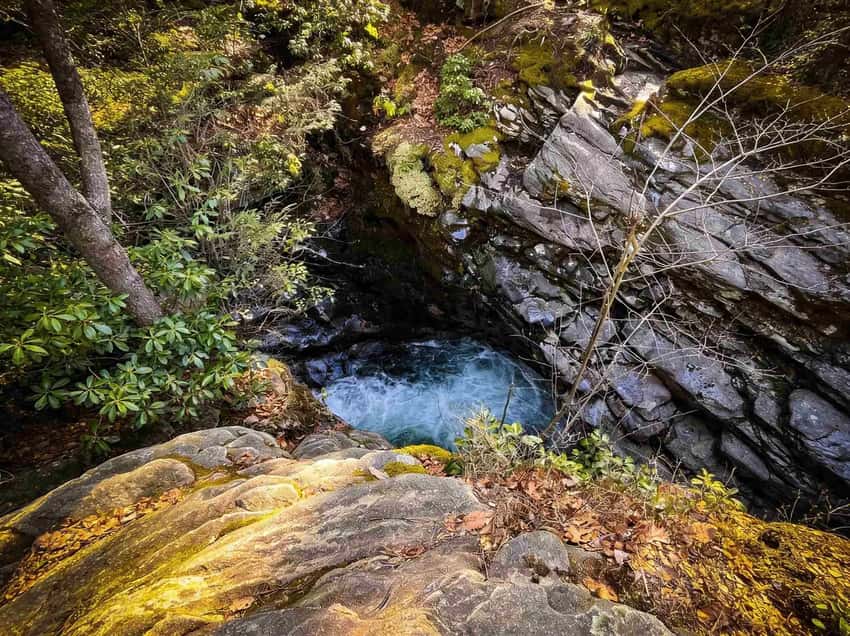
- Visual Reward: A series of glacial potholes (“tubs”) linked by waterfalls in a deep sandstone gorge.
- Route Choice: Choose the 0.3-mile main loop for a quick view, or the 1.8-mile Audubon Loop for a deeper ravine experience.
- Safety Alert: The potholes are strictly off-limits for swimming. Footing is notoriously slick; wear shoes with aggressive rubber treads.
What Changed in the 2024 Reopening
Seven Tubs closed for a full year (2023-2024) for a $1.5 million DCNR rehabilitation project. The improvements are substantial:
- Parking: Main lot expanded and fully paved (59 spaces); overflow lot added
- Route 115 Entrance: Widened to handle traffic flow better
- Wheelbarrow Stream Footbridge: Completely rebuilt and reinforced
- Viewing Platforms: New elevated platforms added overlooking the tubs and waterfalls
- Accessibility: Improved trail surface, new railings, better drainage
The site is now safer, cleaner, and much better maintained than pre-2024. The trade-off is significantly higher visitor volume, especially weekends. Capacity lockdowns are common May-September.
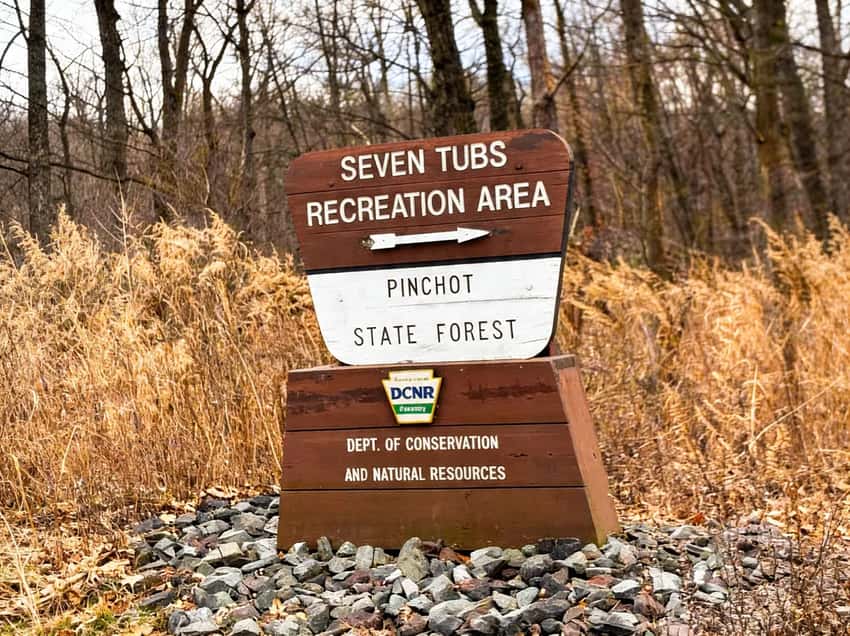
Parking & Getting There
Seven Tubs sits just four miles from downtown Wilkes-Barre, making it extremely popular on weekends. Parking is the biggest constraint of this hike. Once the main lot fills, the park closes. There is no overflow street parking on Route 115.
Main Parking Lot
Address: 900 Bear Creek Blvd, Wilkes-Barre, PA 18702
Capacity: 59 spots (4 ADA-accessible)
Features: New restroom facilities, kiosk with trail maps, trash receptacles
Timing Strategy: Arrive by 8:30 AM on weekends (9:00 AM absolute deadline). On summer Saturdays, expect the lot to be full by 11:00 AM. Weekdays typically fill by mid-afternoon. If you see a “Lot Full” sign at the Route 115 entrance, turn around. Rangers actively enforce the capacity limit.
Overflow Lot
An unpaved pull-off lot sits ~200 yards east of the main entrance. If you see backed-up traffic at the main gate, check the overflow lot first. It fills less frequently but has minimal amenities and longer walking distance to the trailhead.
Best Days to Visit
- Weekday mornings: Empty lots, minimal crowds
- Weekday midday: Still quiet, parking guaranteed
- Weekend mornings before 9 AM: Reliable parking window
- Avoid: Saturday 10 AM-3 PM, Sunday 11 AM-4 PM
The Trails: Two Options
Main Loop: 0.3 Miles (Easy, ~15 minutes)
What it is: The direct route to Seven Tubs. This is what 90% of visitors do: a quick waterfall viewing walk, not a serious hike.
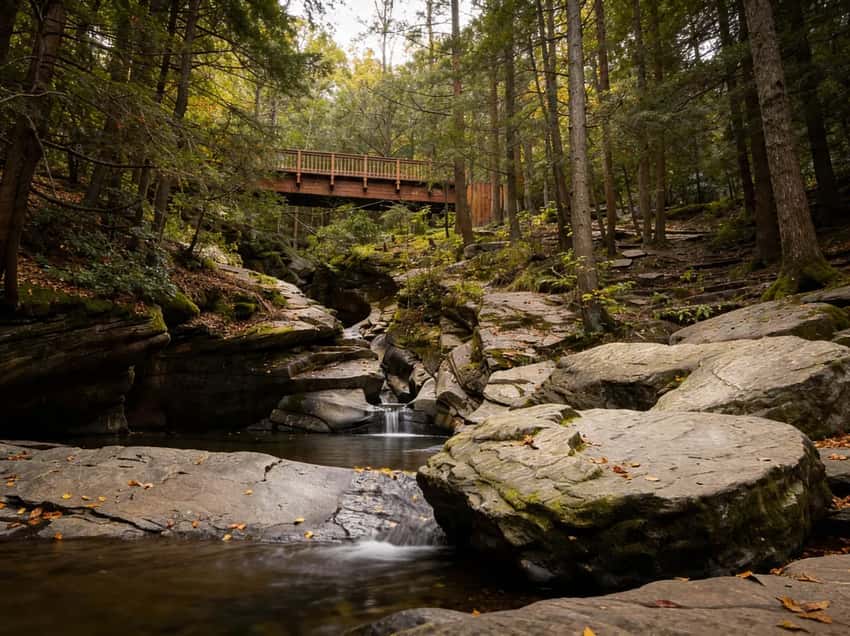
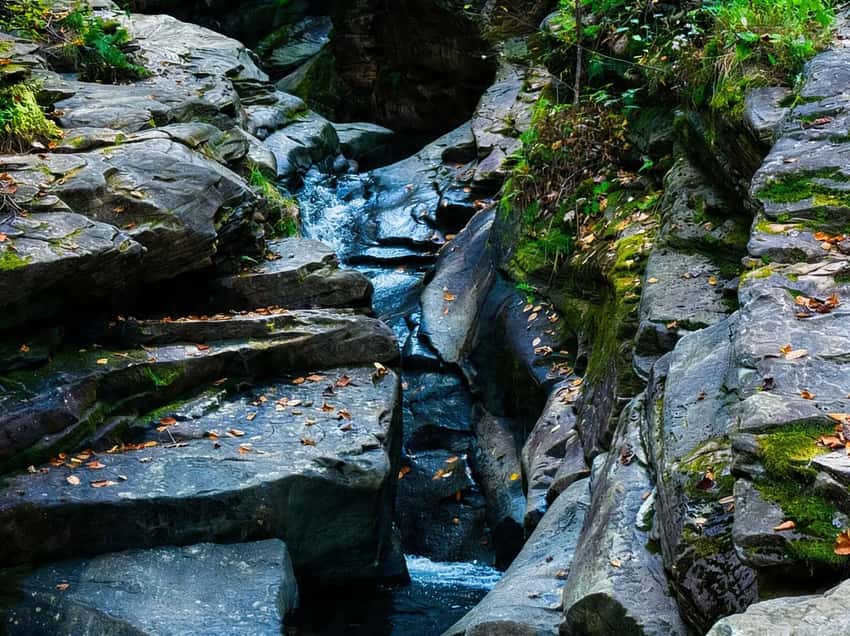
The hike: The trail drops via stone steps to viewing platforms overlooking Wheelbarrow Run. The “tubs” are seven distinct glacial potholes carved into sandstone by swirling meltwater action over 12,000+ years ago. Today they create natural cascades with 10-15-foot drops as the creek flows through them.
Key details:
- Mostly paved/improved trail with railings (post-2024 rehab)
- New viewing platforms offer the best photo angles
- Despite the short distance, footing can be treacherous: sandstone is perpetually moss-covered and slick year-round
- Stone steps, exposed roots, and bare rock require grip footwear (no smooth-soled sneakers)
- Crowded during peak hours but feels natural due to width of platforms
Time: 15-20 minutes for the main loop; add 10+ minutes if you stop for photos
Audubon Loop: 1.8 Miles (Moderate, ~45-60 minutes)
What it is: A deeper ravine hike for visitors wanting more than the quick tub-viewing walk.
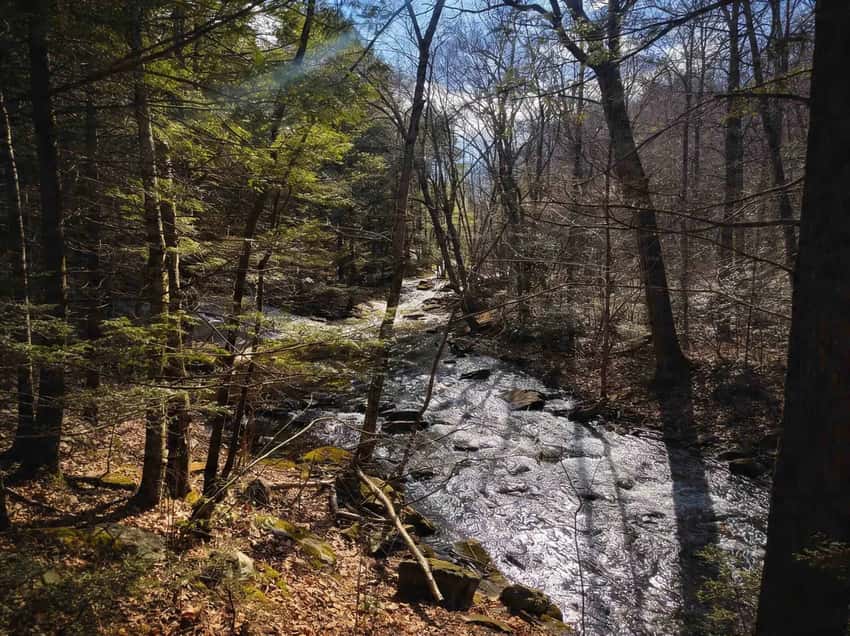
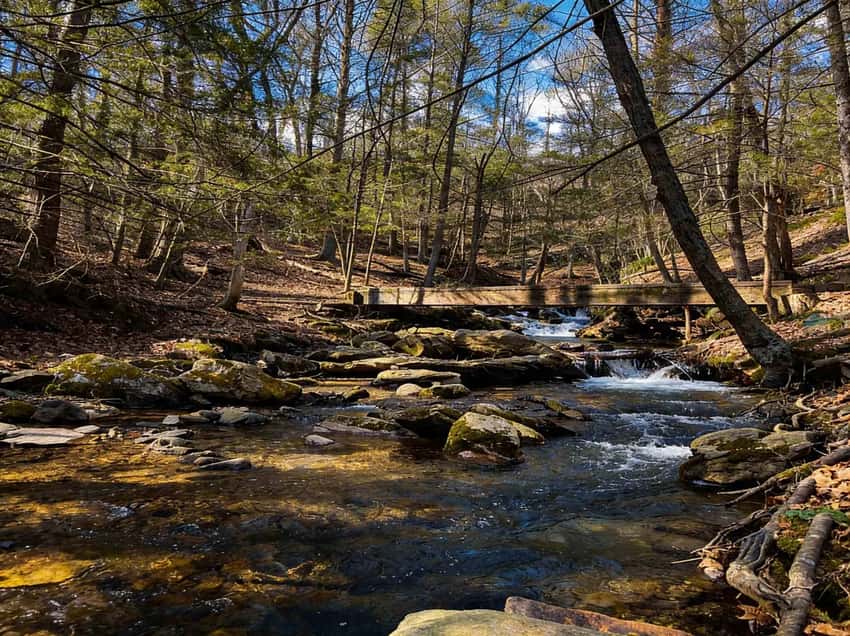
The hike: The loop follows Wheelbarrow Run downstream through a wooded ravine, swinging around to Laurel Run before returning via the main trail. You get the tubs as the grand finale rather than the whole experience.
Key details:
- Moderate difficulty due to a steep ~100-ft descent along Wheelbarrow Run
- Requires careful foot placement; slick rocks and roots are common
- Less crowded than the main loop despite being longer
- Better for experiencing the ravine ecosystem and seasonal color
- Passes small secondary waterfalls and stream crossings
Time: 45-60 minutes at normal pace; longer if you explore side areas
Recommendation: If you have 30+ minutes total, do the Audubon Loop. If you’re in for 20 minutes, stick with the main loop.
Swimming at Seven Tubs: Not Allowed
Can you swim in the tubs? No. DCNR strictly prohibits swimming, jumping, diving, and wading in the potholes and surrounding streams.
Why the restriction? The potholes appear as perfect natural swimming holes, but they’re genuinely hazardous:
- Slick rock surfaces: Moss and algae make standing impossible, even in shallow areas
- Submerged hazards: Rocks, detritus, and irregular bottoms create twisted-ankle risks
- No rescue access: There are no emergency egress points; rangers enforce heavily
- Hypothermia risk: Water stays cold year-round despite summer air temps
Rangers actively patrol weekends and issue citations. Since the 2024 reopening, enforcement has intensified.
Additional restrictions: DCNR also bans open fires, overnight camping, organized picnicking, and loud music. The riparian zone is protected under state regulations.
What to Pack
Essential:
- Grip footwear (non-negotiable): Hiking boots or shoes with deep tread. Sandstone + moss = slippery year-round. Smooth-soled sneakers are an injury risk, even on the short main loop
- Water bottle: 16 oz minimum for main loop; 24 oz+ for Audubon Loop
- Dog leash (if applicable): Required; DCNR enforces this strictly due to narrow ledges and crowding
Recommended:
- Layers: The ravine stays cool even in summer; bring a light fleece for early morning/evening
- Hat + sunscreen: Exposed rock areas reflect UV intensely
- Microspikes (winter only): If temps are below freezing, stone steps become an ice hazard
- Phone/ID: Cell signal is spotty in the ravine
Not allowed: No open fires, camping gear, bicycles, or loud speakers
Best Time to Visit
Spring (April-May)
Peak water flow from snowmelt and rain creates the most dramatic waterfall displays. Wheelbarrow Run is at full strength. Wildflowers dot the ravine. Crowds are moderate. Best for: Photography, waterfall enthusiasts. Avoid: Muddy trail sections.
Summer (June-August)
Water flow drops; the tubs look less impressive. Heat and humidity increase. Parking fills by 11 AM on weekends, so you’ll likely face lockouts. High crowds create congestion on platforms. Only visit: Weekday mornings. Avoid: Saturday afternoons entirely.
Fall (September-October)
Excellent foliage along Laurel Run on the Audubon Loop. Weather is cool and comfortable. Parking moderately busy but less frantic than summer. Water flow is medium (dam-controlled). Best for: Longer hikes, foliage viewing, comfortable temperatures. Peak period: Late September weekends fill quickly.
Winter (November-March)
Few visitors. Stone steps and platforms become icy and hazardous below 32°F. Microspikes are essential. Stream crossings can be slick. DCNR doesn’t close the park, but injuries are common. Water flow remains steady. Only visit: Experienced winter hikers with proper gear. Best for: Solitude.
Bottom Line
Seven Tubs is best enjoyed as a quick morning stop with early arrival (before 9 AM). The hike itself is straightforward and rewarding, but the parking situation means timing is everything. The glacial geology here (those ancient potholes) is genuinely rare; they’re worth seeing despite the logistics.
Don’t attempt this on a summer Saturday afternoon. Do bring grip footwear. Do respect the swimming ban and ranger presence. And do consider combining it with nearby attractions like Concrete City’s poured-concrete ruins or explore the broader Poconos region if you’re spending a full day in the area.
What to Combine with Seven Tubs
Seven Tubs takes 20 to 60 minutes depending on which trail you choose, so it pairs well with other stops in the northeastern Poconos. Here are three natural companions for a full day out.
Concrete City (Nanticoke, ~15 min away): If you enjoy strange history, add Concrete City to your morning. These poured-concrete miners’ cottages were abandoned in the 1920s and swallowed by the woods. The walk in is short and flat, making it a low-effort complement to the tubs.
Bushkill Falls (~45 min away): Billed as the “Niagara of Pennsylvania,” Bushkill is a privately operated waterfall park with boardwalk loops ranging from easy to moderate. It costs an admission fee, but the sheer number of cascades makes it worth stacking after Seven Tubs on a spring trip when water flow is peak.
Hickory Run State Park (~30 min away): Home to the famous boulder field and the Shades of Death scramble trail. If Seven Tubs leaves you wanting more geology, Hickory Run delivers. The flat boulder field walk is accessible to everyone, and the longer trails push into genuine backcountry.
FAQ
Is Seven Tubs free? Yes. DCNR does not charge an entrance or parking fee at Seven Tubs Nature Area. You only pay with your time: show up late and the lot is full.
Are dogs allowed at Seven Tubs? Yes, dogs are allowed but must stay on a leash at all times. The ravine has narrow ledges and slick rock, so keep your dog close and on solid ground. Rangers enforce the leash rule.
How long should I plan for a visit? Budget 20 to 30 minutes for the main loop and 60 to 75 minutes if you do the full Audubon Loop. Add buffer time for photos and for finding parking if you arrive near peak hours.
Nearby Attractions & Hikes
- Concrete City (Nanticoke): Eerie industrial ruins, 15 minutes away
- Bushkill Falls: Scenic waterfall hike in the Poconos, 45 minutes
- Hickory Run State Park: Boulder field and longer trails, 30 minutes
- Laurel Highlands: Multiple state parks and scenic areas, 1 hour
Plan a weekday trip or arrive by 8:30 AM on weekends. You’ll have a better experience and guarantee yourself a parking spot.