Salt Springs State Park: 3-Waterfall Gorge Walk with Old-Growth Hemlock Forest
Three cascades, one ancient hemlock gorge. Walk upstream on Fall Brook to discover all three waterfalls, from the accessible official trail to the hidden lower falls via steep shale.
Key Takeaways
- Navigation: Start at 2305 Salt Springs Road, Montrose, PA 18801 (Google Maps | Apple Maps). GPS: 41.9123, -75.8656.
- Three distinct waterfalls on Fall Brook: Upper Falls, Middle Falls (official trail), and Lower Falls (hidden path via shale).
- Main loop: 1.5-mile circuit combining Fall Brook Trail (0.8-1.0 mi) and Hemlock Trail (0.4 mi).
- Ancient forest: 500-year-old hemlock trees and a boardwalk observation platform overlooking the gorge.
- Difficulty reality: Upper and Middle Falls are moderate; Lower Falls requires scrambling down steep shale and is treacherous when wet.
Most guides describe Salt Springs State Park as an easy waterfall walk. What they don’t tell you: there are actually three separate waterfalls on Fall Brook, and the park sits inside one of Pennsylvania’s rarest old-growth hemlock ecosystems. The Upper and Middle Falls are accessible via a well-maintained trail. The Lower Falls (a hidden 13-foot cascade) requires a steep, slippery scramble down unmarked shale:the kind of path where many hikers turn back.
Located just seven miles north of Montrose on PA Route 29, this 842-acre preserve contains some of the oldest trees in Pennsylvania, sheltered in a hemlock gorge that most casual visitors completely miss.
Why Salt Springs Matters: More Than Just Waterfalls
Salt Springs State Park is unique in Pennsylvania. The waterfalls are the draw, but the forest is what makes the place special. This 842-acre preserve protects one of the state’s last intact old-growth hemlock ecosystems.
The trees here are 300-500 years old, some of the rarest in the Northeast. A raised boardwalk lets you walk among them without damaging the fragile root systems:a conservation-first approach that’s become the park’s signature.
The park is also unusual in its management. It’s the only state park in Pennsylvania run entirely by a non-profit. The Friends of Salt Springs Park took over management in 1994 when the state lacked funds to maintain the historic farm buildings. Today, they manage 842 acres, seven campsites, three cabins, and the entire trail system.
Getting to Salt Springs State Park
Address: 2305 Salt Springs Road, Montrose, PA 18801
Directions from Major Cities:
- From Towanda: ~20 miles south on PA Route 29
- From Bloomsburg: ~30 miles northeast on PA Route 29
- From Scranton: ~50 miles (1 hour) via I-81 to PA Route 29 north
Parking & Trailhead: The main parking area is near the historic Wheaton farm buildings (GPS: 41.9123, -75.8656). The lot holds about 30 cars and rarely fills, even on peak weekends. Free parking, open sunrise to sunset.
Facilities: Restrooms, picnic areas, and drinking water at the main facility. No water sources on the trails themselves:bring what you need.
The Three Waterfalls of Fall Brook
Fall Brook drops through the gorge in three distinct sections. Most hikers only reach the first two. The third requires scrambling and commitment.
The Upper & Middle Falls (Official Fall Brook Trail)
This is the main waterfall experience. The red-blazed Fall Brook Trail runs 0.8-1.0 miles along the creek, climbing gradually to elevation above the water and offering views of both the upper cascade and the middle falls.
What to expect:
- Start from the northeast end of the picnic area
- The path climbs moderately alongside Fall Brook
- You’ll cross the creek multiple times on rock hops (easy in normal water levels, tricky when high)
- Red blazes are visible but occasional
- The trail ends at an overlook above the gorge, giving you perspective rather than close-up waterfall viewing
The falls themselves: The upper falls drops roughly 15 feet over dark sandstone. The middle falls is similar. The water flow is dependant on season:spring runoff (April-May) creates impressive volume and mist. By August, both falls can drop to trickles.
Time: 1-1.5 hours round trip from picnic area
Difficulty: Moderate. The elevation gain is steady but not steep. The rock hopping is easy if water is low, trickier in spring runoff.
The Lower Falls (Unmarked Shale Descent)
The lower falls is a 13-foot cascade that most visitors never see. Reaching it requires leaving the official trail and scrambling down a steep, narrow shale hillside directly beside Fall Brook. This path is not maintained, not marked, and genuinely treacherous when wet.
The approach: From the main park entrance road, look for an unmarked trail near the lower parking area (GPS: 41.912298, -75.865586). The descent is roughly 0.3 miles down and 0.3 miles back up, but it’s all steep.
The shale: This is where the difficulty rating jumps. The hillside is pitched at nearly 45 degrees. The shale is loose and crumbly. When dry, it’s navigable with careful footing.
When wet, it offers zero traction. Hikers regularly report walking directly up the creek bed instead of using the shale path in muddy conditions:the water is usually knee-deep but more stable than the embankment.
⚠️ Critical Warning: Do NOT attempt this in rain, during or immediately after rain, or during mud season (mid-March through April). The shale becomes lethally slippery. Ankle twists and falls are common.
If you slip, you slide directly toward the creek. It’s not technically a cliff, but it’s dangerous enough that many experienced hikers skip this part entirely.
The reward: A quiet, lesser-known cascade with genuine wilderness feel. The gorge narrows here, and you get intimate waterfall views without the crowds.
Time: 30-45 minutes for the descent and return, assuming good footing
Difficulty: Strenuous. Steep, loose terrain, high injury risk if footing is poor.
Pro Tip: The Complete Loop
Don’t treat the Falls Trail and Hemlock Trail as separate hikes. Combine them: Fall Brook Trail (1.0 mile up to Upper/Middle Falls) + Hemlock Trail (0.4 mile back to start via old-growth forest) = 1.5-mile complete loop without retracing steps.
This gives you the waterfall experience AND the ancient forest without the walking-twice issue.
The Hemlock Trail: Walking Among 500-Year-Old Trees
This is the secret part of Salt Springs that most guidebooks skip. The Hemlock Trail (0.4 miles) features a raised boardwalk that winds through the park’s most pristine old-growth forest section. The hemlocks here exceed 500 years in age. These are genuinely ancient trees, and the boardwalk design prevents root damage from heavy foot traffic.
What you’ll see:
- Trees 4-6 feet in diameter at the base
- Massive hemlock and white pine towering 100+ feet overhead
- A suspended observation platform that juts out over the gorge:you’re literally walking out over empty space, getting eye-level views of the tree canopy
- The sense of walking through a cathedral, which is exactly the design intention
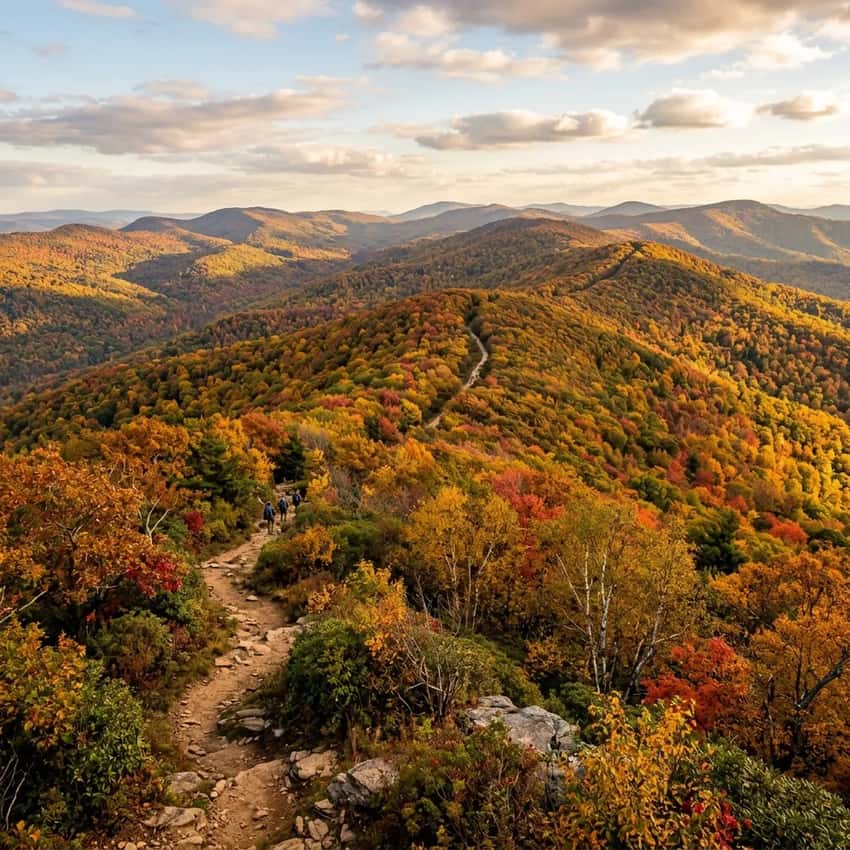
Best time: Any season, but fall (September-October) with the deciduous understory turning color while the evergreens stay deep green is genuinely magical.
Time: 20-30 minutes for the Hemlock Trail alone
Difficulty: Easy. The boardwalk is perfectly maintained and flat. Accessibility is excellent:people in wheelchairs can access the observation platform.
Photography: This is one of the best spots in the Poconos for photographing old-growth forest. Overcast days eliminate harsh shadows and highlight the green. Early morning and late afternoon light create dimensional depth.
Insider Tips: How to Hike Salt Springs Like a Local
Spring Timing: Waterfall volume is best in April-May when snowmelt feeds Fall Brook. This is also peak muddy season, so the Lower Falls shale path is at its worst. Go early season (mid-April before peak mud) for good water and better footing.
Summer Strategy: By July, both Upper and Middle Falls can be reduced to trickles. If you’re visiting summer, focus on the Hemlock Trail and the forest experience rather than waterfall hunting. The boardwalk and observation platform are excellent regardless of water volume.
Fall Sweet Spot: Late September through mid-October offers good water volume, foliage color, and stable footing. This is the best overall season. The park can be busy on weekends, but the trails are never crowded like Ricketts Glen.
Avoid Lower Falls in Rain: Seriously. The shale becomes a skating rink. Even experienced hikers report slipping. Save the Lower Falls for clear, dry days when the shale is bone-dry.
Parking Hack: The park rarely fills, but if you arrive on a summer weekend and the main lot is busy, there’s overflow parking along the entrance road. Call ahead (Friends of Salt Springs Park) if you’re concerned.
Tick Check: This region has serious tick density. Wear light pants, tuck them into socks, and do a full-body check within 2 hours of finishing. Spring (April-June) is peak season:use DEET-containing repellent.
Photography Tips for Salt Springs
Waterfall Photography: The Upper and Middle Falls don’t have dramatic drop heights, so angle matters. Shoot from low angles to emphasize the cascade flow. Overcast days give even lighting. Bring an ND filter if you have one:a 1-2 second exposure creates silky water effect, even in daylight.
Old-Growth Forest: The Hemlock Trail boardwalk offers exceptional forest photography. Wide-angle lenses (16-35mm) capture the towering scale. Shoot upward into the canopy:the green filtered light creates mood.
Overcast days are best. The observation platform gives unique elevated perspectives.
Gorge Views: The observation platform on the Hemlock Trail is the premiere gorge photo spot in the park. It’s genuine photography-worthy because you’re suspended above the gorge, not just looking at it from a trail edge. Bring a polarizing filter to cut glare from water.
Fall Colors: If visiting late September-October, position yourself on the platform with the forested hillsides in background. The color contrast between evergreen hemlocks and deciduous fall foliage is distinctive to this region.
Best Time to Visit Salt Springs
- Spring (April-May): Peak waterfall flow, wildflower blooms, high tick activity. Best for waterfall hunters. Expect mud.
- Summer (June-August): Waterfalls often reduced to trickles. Focus on forest hikes and the old-growth boardwalk. Hot and humid.
- Fall (September-October): Ideal season. Good water volume, foliage color, stable footing, fewer ticks. Mid-September to mid-October is optimal.
- Winter (November-March): Quiet and peaceful. Boardwalk is icy but navigable with microspikes. Waterfalls often frozen. Beautiful but requires winter footwear.
FAQ: Salt Springs State Park
Can you swim at Salt Springs? No. The water beneath each cascade is typically only 1-2 feet deep, and the rocks are notoriously slippery. Swimming is not safe and is not recommended.
How crowded is Salt Springs? Very uncrowded. Even on summer weekends, the park sees a fraction of the traffic that Ricketts Glen or other popular waterfalls attract. This is one of the least crowded waterfall destinations in the Poconos.
What’s the best hike for first-timers? The main Fall Brook Trail (0.8-1.0 miles) + Hemlock Trail loop (1.5 miles total). This gives you waterfalls and old-growth forest without technical terrain. Skip the Lower Falls scramble until you’re confident with shale.
Is the Lower Falls worth the effort? Only if you enjoy technical terrain and don’t mind the risk of slipping. The falls itself isn’t dramatically different from the Upper and Middle Falls. The experience is more about the challenge than the reward. Many seasoned hikers skip it entirely.
How long should I plan for?
- Fall Brook Trail alone: 1-1.5 hours
- Fall Brook + Hemlock Trail loop: 1.5-2 hours
- With Lower Falls detour: 2.5-3 hours
What should I bring?
- Water bottle (at least 1 liter, no refill on trail)
- Sturdy hiking boots (not trail runners, especially if considering Lower Falls)
- Insect repellent (spring-fall)
- Tick check kit (tweezers)
- Camera for forest photography
Are dogs allowed? Yes, on leash. The trail system is dog-friendly. Dogs should not attempt the Lower Falls scramble:the shale is rough on paws.
Explore More in the Poconos
Salt Springs is just one piece of the Poconos waterfall experience. Check out the complete Poconos region guide for Ricketts Glen, the boardwalks at Bushkill Falls, the gorge trails near Glen Onoko, and other cascades. If you want old-growth forest combined with waterfalls, Ricketts Glen State Park offers a similar experience with more dramatic drops and infrastructure.
For more waterfall content, see the PA Waterfalls feature guide.
Last updated: April 17, 2026. Trail conditions change seasonally. Check Friends of Salt Springs Park for current conditions and seasonal updates.